How to Become Job Ready in 6 Months After Graduation (Step-by-Step Guide for Students – 2026)
You finished your graduation.
Now comes the question everyone asks:
“Did you get a job?”
If you feel confused, stressed, or unsure about what to do next — you are not alone. Most graduates in India face this exact situation.
The truth is simple:
👉 A degree gives knowledge.
👉 Skills make you job ready.
The good news?
You can become job ready in 6 months if you follow the right plan.
Let’s go step by step.
To become job ready in 6 months after graduation, students should choose one career skill, learn through practical training, work on live projects, build a portfolio, improve communication skills, and prepare for interviews consistently.
Why Many Graduates Struggle to Get Jobs
This is not your fault.
Colleges mostly focus on theory, but companies look for:
- Practical skills
- Tool knowledge
- Real project experience
- Communication ability
- Problem-solving mindset
According to reports by the National Skill Development Corporation, many graduates require additional skill training before becoming employable.
That’s why students today choose skill training institutes after graduation.
If you are still deciding your career direction, this guide will help
Step 1: Choose One Career Skill (Week 1)
Many students make one mistake — learning too many things at once.
Instead, choose one career path based on interest and job demand.
Popular Job-Ready Skills in 2026
- Digital Marketing
- Full Stack Development
- Data Science & Analytics
- Artificial Intelligence & Machine Learning
- UI/UX Design
- Automation & Business Tools
You can explore all career options here
If you want structured IT learning, check
Example
Rahul completed B.Com but didn’t know coding.
He chose digital marketing because it required creativity + practical skills.
Within months, he started handling social media campaigns during training.
Career clarity changed everything.
Step 2: Learn Through Practical Training (Month 1–3)
Watching videos alone is not enough.
Companies hire students who have hands-on experience.
A good training program should include:
✔ Live projects
✔ Tool practice
✔ Mentor support
✔ Assignments based on real scenarios
Some career-focused programs students choose:
The World Economic Forum highlights that reskilling is one of the most important factors for future employment.
Step 3: Work on Live Projects (Month 2–4)
Projects make you confident.
Instead of saying “I learned digital marketing”, you can say:
✅ “I managed a campaign.”
✅ “I built a website.”
✅ “I analyzed real data.”
This makes recruiters trust you.
Learn how project-based learning works here
Example
Meena, an engineering graduate, struggled in interviews earlier.
After completing live projects during training, she could explain her work clearly — and cleared interviews confidently.
Step 4: Build Your Portfolio & Resume (Month 3–5)
Your resume should show skills, not just marks.
Add:
- Projects
- Certifications
- Tools used
- Internship experience
Skill specializations that help portfolios:
For resume tips, students often follow career guidance from LinkedIn career resources.
Step 5: Improve Communication & Soft Skills (Month 4–5)
Many students know skills but feel nervous during interviews.
That’s normal.
Employers check:
- Communication clarity
- Confidence
- Team interaction
- Presentation skills
Soft skills training helps remove fear:
Step 6: Prepare for Interviews & Placement (Month 5–6)
Now your goal is simple — convert skills into a job.
Focus on:
- Mock interviews
- Resume correction
- HR questions
- Technical practice
Placement assistance plays a big role
Industry body NASSCOM also emphasizes skill-based hiring growth in India.
Your 6-Month Job Readiness Plan
| Month | Focus |
|---|---|
| Month 1 | Choose skill & basics |
| Month 2 | Core learning |
| Month 3 | Practical projects |
| Month 4 | Advanced tools |
| Month 5 | Portfolio + communication |
| Month 6 | Interview preparation |
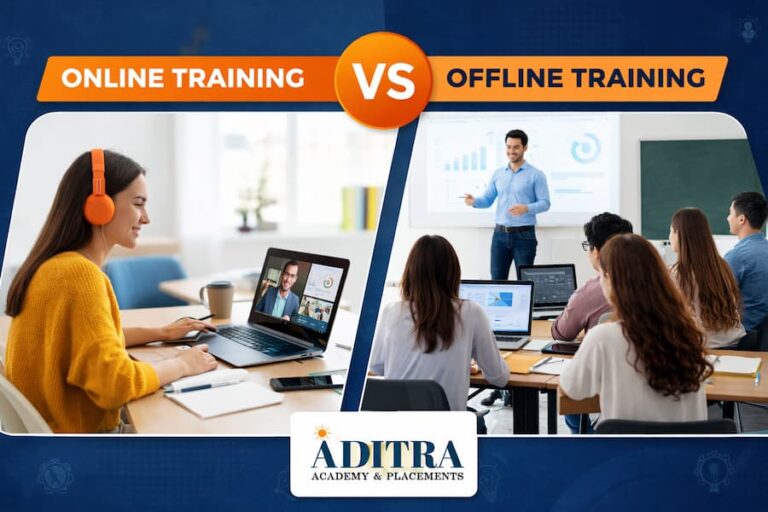
Online or Offline Training — Which Is Better?
Both work if learning is practical and guided.
Read detailed comparison here:
👉 https://aditra.in/online-vs-offline-training-skill-development/
Why Skill Training Matters More Than Degrees Today
Companies now prefer candidates who can do the work immediately.
If you want to understand this industry shift:
👉 https://aditra.in/practical-training-vs-degree-2026-india/
You can also explore career-focused learning paths here:
👉 https://aditra.in/career-oriented-courses-in-india/
How Aditra Helps Students Become Job Ready
At Aditra, the focus is simple — make students confident professionals.
Students benefit from:
✅ Practical learning approach
✅ Industry-oriented courses
✅ Mentor guidance
✅ Multiple career options
✅ Placement support
Explore professional training programs:
Final Thoughts
You don’t need years to become job ready.
You need:
✔ The right skill
✔ Practical training
✔ Real projects
✔ Consistent practice
Start small. Stay consistent. Follow a structured plan.
Your first job can happen sooner than you think.
Can I become job ready in 6 months?
Yes, with focused skill training, practical projects, and interview preparation, many students become job ready within 6 months.
Which course is best after graduation for jobs?
Digital marketing, data science, full stack development, AI, and analytics courses are popular job-oriented options.
Do companies prefer skills or degrees?
Most companies prefer candidates with practical skills and real project experience along with academic qualifications.